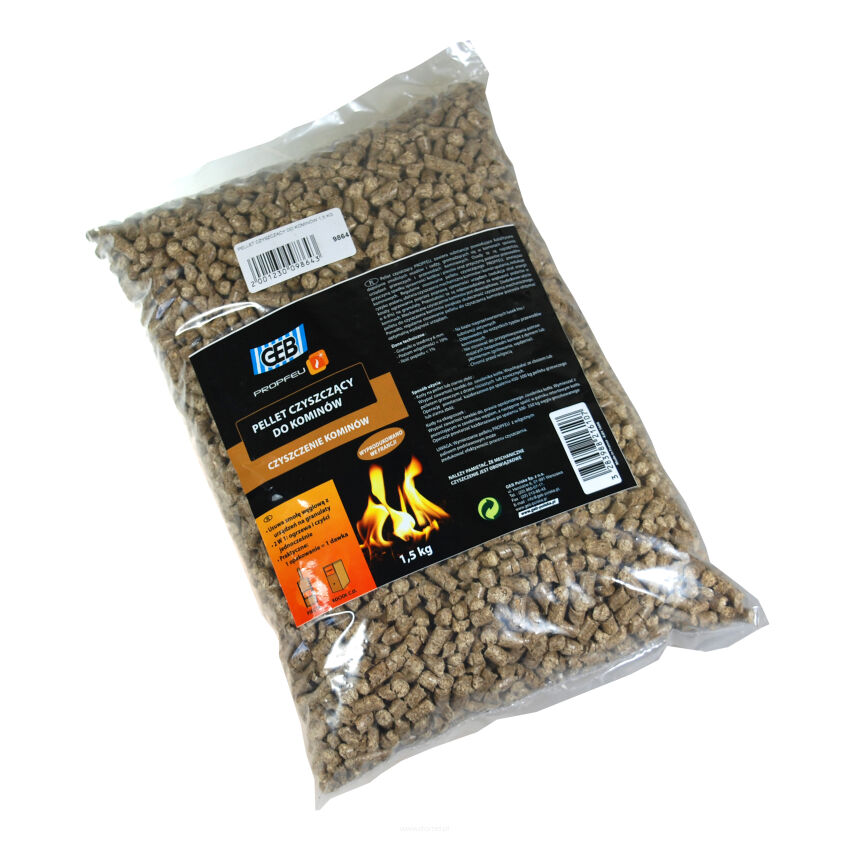
Cleaning pellet for chimneys granulate GEB 1.5 kg
- Watch the product:
- Add feedback:
- Code: 9864
- Manufacturer: GEB
- Manufacturer's code: 3283988216107
- Weight: 1.50 kg
- Availability: None
-
- Net Price: €3.52 €4.33
- szt.
-
 Payment in cash, Payment via bank transfer, Online Payments Payment Cards, ApplePay, Google Pay - P24, PayPro SA, Osobista płatność przy odbiorze, Płatność odroczona (tylko dla zweryfikowanych Klientów), eService (card or bank transfer), Zapłacę przy odbiorze listonoszowi, Payment by bank transfer - wait for the proforma invoice to be sent, Zapłacę przy odbiorze kurierowi Inpost
-
 Fast Blik payments.
The product is shipped within 24 hours.
We complete the order within 24 hours.
You can return the product within 14 days.
CLEANING PELLET FOR FIREPLACES GEB - PACKAGE 1.5 KG
Special features:
-
perfectly cleans and maintains the combustion chamber
-
reduces the emission of harmful compounds into the atmosphere
-
ecological agent
-
helps burn off soot
-
most popular on the market
-
in pellet form
TECHNICAL DATA
- granules with a diameter of 6mm
- moisture level <10%
- ash content <1%
- based on unprocessed flax husks and active substances
- suitable for all types of chimney flues
- do not use for preparing dishes that have direct contact with smoke and fire (grilling, smoking)
- protect from moisture
PRODUCT DESCRIPTION
Propfeu cleaning pellet contains substances that cause catalytic afterburning of tar deposits and soot accumulating in the combustion chambers of heating devices and chimney flues. These deposits are the most common cause of reduced efficiency of boilers and stoves and the cause of chimney fires. Regular use of GEB cleaning pellet reduces the risk of fire, facilitates mechanical cleaning of chimneys and combustion chambers, reduces heating costs by improving device efficiency (reducing energy losses by 6-8%) on granules. These residues are responsible for most chimney fires. Mechanical chimney cleaning is mandatory. Additional use of pellet for chimney cleaning increases the effectiveness of mechanical cleaning. Moreover, regular use of pellet for chimney cleaning helps maintain optimal device performance.
How to use:
Pellet or grain boilers - Pour the contents of the bag into the boiler's hopper. Co-burn with grain or heating pellet. Repeat the operation each time after burning 450 - 500 kg of pellet or grain.
Eco-pea coal boilers - Pour the contents of the bag into the almost empty boiler hopper. Mix with the remaining coal in the hopper, then burn in the boiler's retort burner. Repeat the operation each time after burning 300 - 350 kg of coal.
Warning! Mixing cleaning pellet with wet fuel may reduce its efficiency.
WHY CLEAN THE BOILER
To economize fuel consumption and achieve the declared power and thermal efficiency of the boiler, it is necessary to keep the combustion chamber and convection channels properly clean. While using our central heating installation properly, we cannot prevent dirt inside the boiler, which is the heat source. Burning solid fuels causes soot and ash to deposit on the walls of flue gas ducts. This, in turn, causes a decrease in the boiler's thermal power and an increase in fuel consumption. This is caused by reduced chimney draft and accelerated fuel combustion. Therefore, to prevent deterioration of the thermal properties of our boiler, we should not forget to clean it frequently.
In the boiler's combustion chamber, special attention should be paid to periodic cleaning of microcracks in the automatic grate plate. Cleaning of convection channels, where volatile ashes settle, should be done systematically every 3 to 7 days, especially when using the boiler in "traditional grate" mode. An important issue is the frequency of cleaning the central heating boiler. If the fuel burned is coal or suitable quality wood, cleaning once every few weeks should suffice. However, if burning coke, cleaning should be done significantly more often - once every 7 to 10 days. Also, once every few years, the boiler should be cleaned of so-called scale. For this, special solutions dissolving deposits are used (e.g., aqueous hydrochloric acid solution).
Tools equipped with the boiler are used for cleaning. Cleaning of the boiler's convection channels is enabled by front cleaning doors and ignition-filling doors. Additionally, periodic cleaning of the air chamber located at the rear of the boiler, where dust falling from the automatic grate plate accumulates, should be performed. This cleaning is done through the side cleaning door.
Wire brushes or pokers are used for cleaning solid fuel boilers. Large boilers can be cleaned with compressed air. Cleaning is done through the boiler's cleaning openings, remembering to keep the flue damper open. Boilers may have numerous such openings located in various places (top, side, or rear). Remaining ash is cleaned through the lower cleaning door of the boiler with the help of a scraper. After finishing work, remember to hermetically close all cleaning openings.
Cleaning the chimney flue is also essential for proper boiler operation.
After the heating season or in other cases of planned boiler shutdown, the loaded portion of fuel should be burned out. After extinguishing the boiler and cooling it down, all residues of burned fuel should be removed from the grate and the entire boiler cleaned and maintained. Maintenance should include lubricating the internal partitions of the combustion chamber and all moving parts with oil. During the boiler downtime, special care should be taken to protect the fuel feeding mechanism to the combustion chamber by lubricating the horizontal guides.
 Polish
 Czech
Czech
 German
 Slovak
 Ukrainian