 Zapraszamy do sklepu http://www.example.com |
Pełna nazwa firmy ullica nr kod Miasto tel. +48 00 0000-000 |
Catalyst for soot combustion SADPAL bag 1 kg
Produkty > Akcesoria do kotłów > Cleaning of the boiler, ramrod, brush, Sadpal, Spalsadz
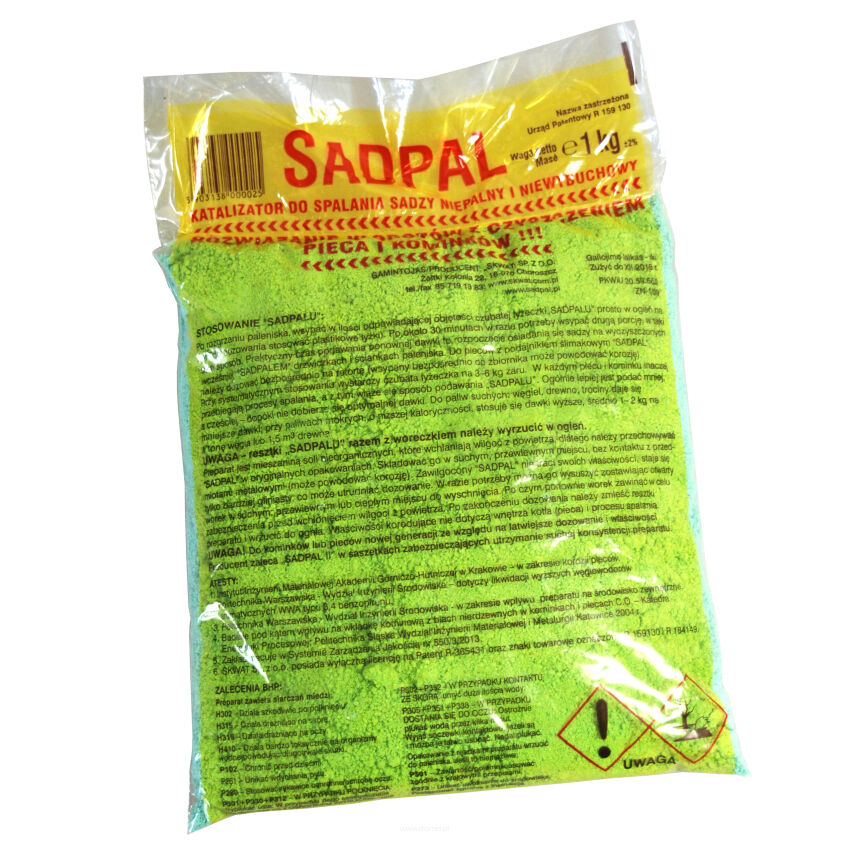
Producer: SKWAT
Producer code: 5903138000025

Weight: 1kg
Price gros: €3.81
Price net: €3.10
The preparation is used for cleaning central heating boilers, chimney flues, and fireplaces from soot.
Characteristics:
Sadpal is a mixture of inorganic salts that decompose at high temperatures into substances with catalytic properties. It is used to burn soot and tar deposits in the firebox and chimney flues.
How to use:
Apply to a well-lit boiler (the preparation works only at sufficiently high temperature), initially using a dose that causes the smoke coming out of the chimney to be white. The powder can be applied by sprinkling it on the fuel in a ratio of 1-2 kg per 1 ton or by pouring it directly into the firebox.
We sell the SADPAL catalyst in 1 kg packages.
After the heating season ends or in other cases of planned boiler shutdown, the loaded portion of fuel should be burned out. After extinguishing the boiler and cooling it down, all residues of burned fuel should be removed from the firebox, and the entire boiler should be cleaned and maintained. Maintenance should include lubricating the internal partitions of the firebox and all moving parts with oil. During the boiler's downtime, special care should be taken to protect the fuel feeding mechanism to the firebox by lubricating the horizontal guides.
Catalyst for soot combustion additive for solid fuels.
Used for complete afterburning of soot in any part of the boiler (firebox, combustion chamber, chimney ducts).
NOT EXPLOSIVE OR FLAMMABLE.
CERTIFICATES
* "SADPAL" has a certificate from the Warsaw University of Technology and the Institute of Inorganic Technology ITN/99/90.
* "SADPAL" has an expert opinion from the Institute of Materials Engineering of the AGH University of Science and Technology in Krakow - regarding furnace corrosion.
* "SADPAL" has an expert opinion from the Warsaw University of Technology - Faculty of Environmental Engineering concerning the elimination of higher aromatic hydrocarbons PAHs such as 3,4-benzopyrene.
* "SADPAL" has an opinion from the Warsaw University of Technology, Faculty of Environmental Engineering, regarding the impact of the preparation on the external environment.
* "SADPAL" has an opinion from the Silesian University of Technology - Faculty of Materials Engineering and Metallurgy concerning the impact of the preparation on stainless steel chimney liners in fireplaces and central heating boilers.
REDUCTIONS IN AIR POLLUTION FEES
With systematic use of "SADPAL" discounts in fees are possible:
- up to 55% for fixed grate
- up to 25% for moving grate
USING "SADPAL" ELIMINATES:
1. atmospheric pollution by soot (black smoke),
2. higher aromatic hydrocarbons PAHs such as 3,4-benzopyrene,
3. carbon monoxide emissions to the atmosphere,
4. the need for mechanical cleaning of boilers from soot (deposits),
5. downtime related to cleaning the furnace from soot (deposits),
6. reduces the frequency of soot ignition in the chimney.
CAUSES REDUCTION OF:
1. sulfur dioxide emissions to the atmosphere by 12-20% due to coal savings,
2. coal consumption depending on its calorific value by 12-20%,
3. SO2 and NOx content in flue gases by 10-20%,
4. corrosion rate of steel structural materials of grate fireboxes and flue gas exhaust installations,
5. improves the efficiency of cyclones, multicyclones, and electrostatic precipitators.
USAGE PROPERTIES AND APPLICATION OF "SADPAL"
"SADPAL" is a green powder - a mixture of inorganic salts that decompose at temperatures above 650°C into substances with catalytic properties.
It is used for afterburning soot and organic substances into the final products - carbon dioxide and water.
Using "SADPAL" does not damage grate fireboxes and flue gas exhaust installations - on the contrary, it extends their lifespan (expert opinion AGH Inst. of Materials Engineering in Krakow dated 1991.02.20).
"SADPAL" improves the lifespan and efficiency of cyclones, multicyclones, and electrostatic precipitators.
It is neither flammable nor toxic, not explosive, and does not pose hazards due to improper use or overdose. It has been successfully used since 1991 in hundreds of plants and by thousands of individual users.
"SADPAL" eliminates soot and coke by afterburning them. Unburned hydrocarbons including benzopyrene are afterburned along with soot. Carbon monoxide oxidizes to carbon dioxide.
Reduction of SO2 levels in exhaust gases by 10-20% and NOx by 5-10% is the effect of their binding by components of "SADPAL".
"SADPAL" exhibits activity in the following areas:
* cleaning action on boiler surfaces,
* improving combustion processes - reducing solid particle lift and carbon dioxide concentration in flue gases,
* reducing SO2 and NOx emissions,
* limiting high and low temperature corrosion,
* reducing dust emissions.
Systematic use of "SADPAL" in the proportion of 1.5-3 kg per 1 ton of coal causes elimination of deposits - slag in the furnace and heating installation, maintaining their efficiency during the heating season.
As a result, downtime for furnace cleaning is short and only involves cleaning ash from the rear part of the furnace. After using "SADPAL" - due to burning off the binder which is soot - the crust (deposits) changes its structure, loosens, and falls off. The new coating is burned off continuously - furnace walls remain clean.
"SADPAL" does not cause glazing (screens) of heating elements - it does not contain dolomite in its composition.
Due to the above advantages, it is widely used in the operation of boilers fired with coal, fine coal, coke, wood, peat, lignite, both in small, medium, and large boiler rooms. It significantly improves boiler efficiency by keeping boiler walls clean. Every millimeter of deposit (slag, crust) on the furnace wall increases solid fuel consumption by 10%.
HOW TO USE
For boilers, initially apply such a dose of the preparation that the smoke coming out of the chimney is white (e.g., for a boiler with a total surface area of 25 m2 about 6 kg of preparation), then introduce "SADPAL" into the boiler together with the fuel mixed in the proportion of 1.5-3 kg of preparation per 1 ton of coal. In large boilers, the powder can be introduced using a small screw conveyor powered by a DC motor (with variable speed), located above the coal (fuel) feeder.
For small boilers, the powder is applied by sprinkling coal (in a wheelbarrow, on a pile) in the appropriate proportion of 1.5-3 kg per 1 ton.
Flue gases coming out of chimney ducts, when "SADPAL" is used correctly, should have a white coloration.
COST-EFFECTIVENESS OF USING "SADPAL". ECOLOGICAL EFFECTS
* elimination of soot by its complete combustion,
* elimination of benzopyrene,
* reduction of carbon monoxide emissions, total gas emissions reduced by 10-20% due to savings on solid fuel,
* reduction of SO2 emissions by 10-20% and NOx by 5-10%,
* reduction of slag and ash production resulting from fuel savings,
* reduction of dust emissions.
"SADPAL" should be stored in dry, cool, not too drafty rooms, protected from water.
"SADPAL" should be transported in covered means of transport in accordance with applicable regulations.
WHY CLEAN THE BOILER
To economize fuel consumption and achieve the declared power and thermal efficiency of the boiler, it is necessary to keep the combustion chamber and convection channels properly clean. While using our central heating installation properly, we cannot prevent dirt inside the boiler, which is the heat source. Burning solid fuels causes soot and ash to deposit on the walls of flue gas ducts. This, in turn, causes a decrease in the boiler's thermal power and an increase in fuel consumption. This is caused by reduced chimney draft and accelerated fuel combustion. Therefore, to prevent deterioration of the thermal properties of our boiler, we should not forget to clean it frequently.
In the boiler firebox chamber, special attention should be paid to periodic cleaning of micro gaps in the automatic grate plate.
Cleaning of convection channels, where volatile ashes settle, should be done systematically every 3 to 7 days, especially when using the boiler in "traditional firebox" mode. An important issue is the frequency of cleaning the central heating boiler. If the fuel burned is coal or suitable quality wood, cleaning once every few weeks should suffice. However, if burning coke, cleaning should be done more frequently - once every 7 to 10 days. Once every few years, the boiler should be cleaned from so-called scale. For this, special solutions dissolving deposits are used (e.g., aqueous hydrochloric acid solution).
Tools equipped with the boiler are used for cleaning. Cleaning of the boiler's convection channels is enabled by front cleaning doors and firing/loading doors. Additionally, periodic cleaning of the air chamber located at the rear of the boiler, where dust falling from the automatic grate plate accumulates, should be performed. Such cleaning is done through the side cleaning door.
For cleaning solid fuel boilers, wire brushes or pokers are used. Large boilers can be cleaned with compressed air. Cleaning is performed through the boiler's cleaning openings, remembering to keep the flue damper in the flue pipe open. Boilers may have numerous such openings located variously (top, side, or rear). Remaining ash is cleaned through the lower cleaning opening of the boiler using a scraper. After finishing work, it is necessary to hermetically close all cleaning openings.
Also important for proper boiler operation is cleaning the chimney duct.
After the heating season or in other cases of planned boiler shutdown, the loaded portion of fuel should be burned out. After extinguishing the boiler and cooling it down, all residues of burned fuel should be removed from the firebox and the entire boiler cleaned and maintained. Maintenance (by oiling) of internal partitions of the firebox chamber and all moving parts should be performed. During the boiler downtime, special care should be taken to protect the fuel feeding mechanism to the firebox chamber by lubricating the horizontal guides.
Product options
 Polish
 Czech
Czech
 German
 Slovak
 Ukrainian