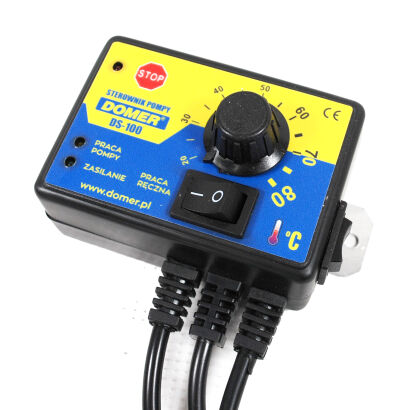
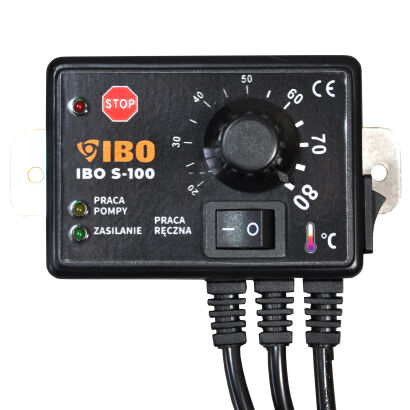
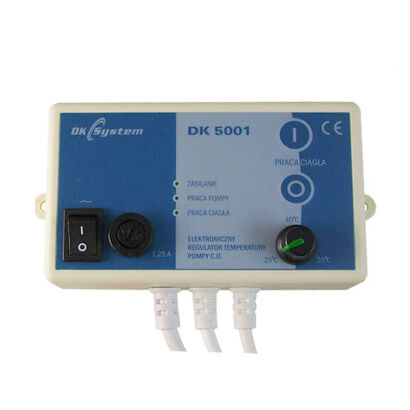
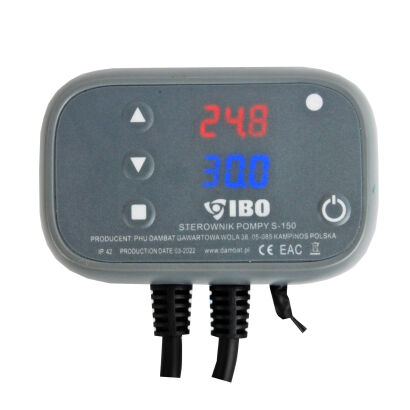
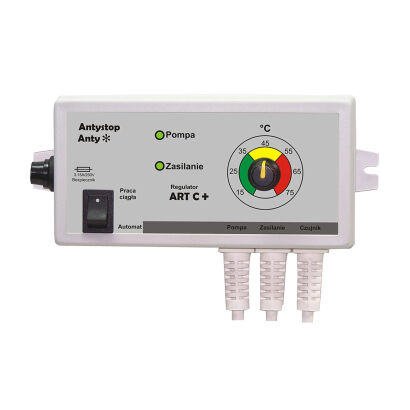
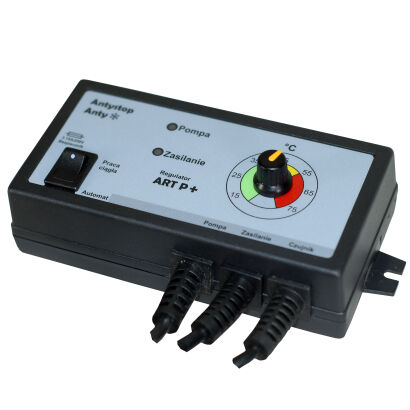
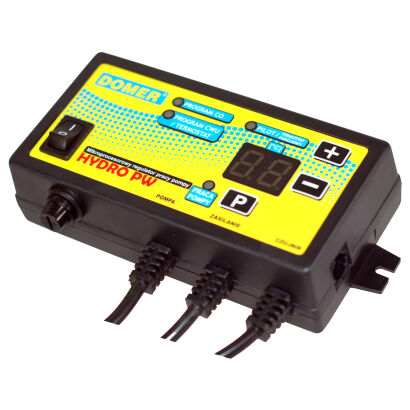
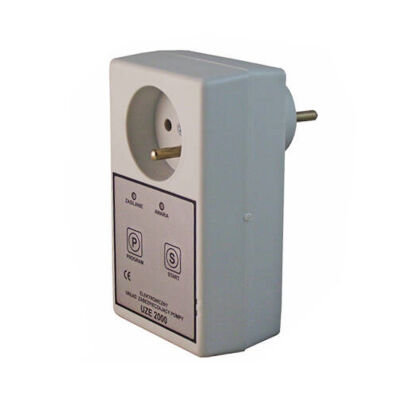
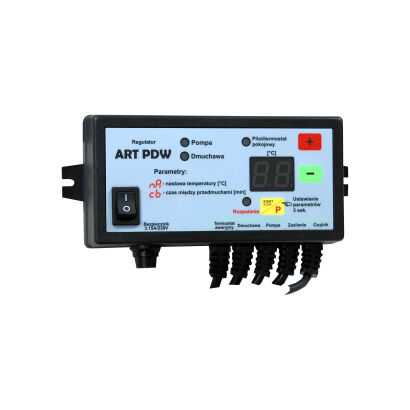
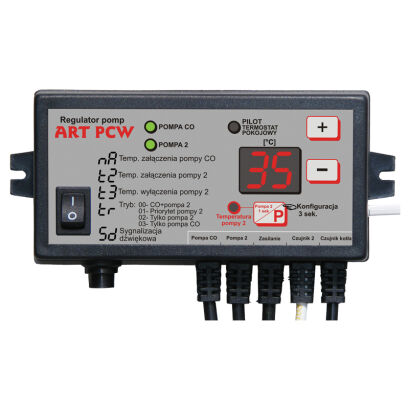
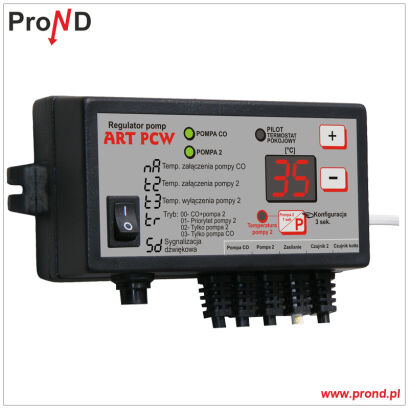
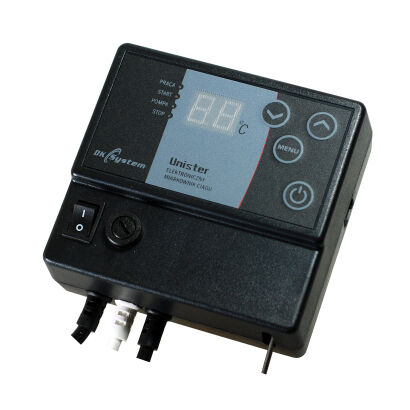
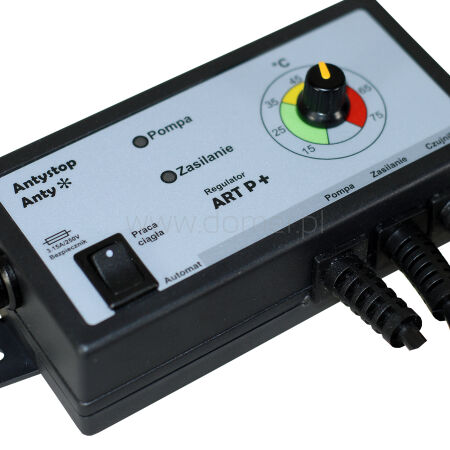
The central heating pump controller is selected based on the system it is to serve, not just the boiler's name. This category includes controllers for CO pumps, DHW pumps, and circulation pumps, as well as versions cooperating with two pumps or with a blower, so you can choose control for the CO installation, DHW tank, and solid fuel boiler without modifying the entire automation.
How does the central heating pump controller work?
The central heating pump controller is responsible for automatically turning the pump on and off after reaching the set temperature. A temperature sensor mounted on the boiler or supply pipe measures the water temperature, and the controller compares it with the set value and runs the circulation pump only when needed.
The temperature sensor is crucial here because the pump start time, heating of the installation, and protection of the boiler from unnecessary cooling depend on its reading. In simple systems, such a CO pump controller operates one pump, while in more complex ones it can also act as a controller for the DHW circulation pump or simultaneously control CO and DHW circuits.
Which circulation pump controller fits a given installation?
Selection starts by checking how many elements the controller must operate and how the heat source works. One circulation pump controller is enough for a single radiator circuit, while a different one is needed in a boiler room with a tank, two pumps, or a blower.
| System | Control range | Application |
|---|---|---|
| One CO pump | Switching on after reaching the set temperature | Simple central heating circuit |
| One DHW pump | Tank charging | Domestic hot water control |
| Two pumps | Separately CO and DHW | Installation with boiler priority or two circuits |
| Pump and blower | Circuit and air blast regulation | Solid fuel boiler |
In everyday selection, the regulation method and ease of use also matter. An analog version with a knob works well where quick adjustment is important, while an electronic pump controller with a temperature sensor, display, and thermostat operation option provides greater control over the circuit and more precise setting adjustments.
Settings that organize pump operation
The central heating pump controller should start the pump after the water is actually heated, neither too early nor delayed. In practice, setting the switch-on temperature within the range provided by the controller, often 20-80 °C, and selecting hysteresis, i.e., the temperature difference at which the pump will turn off after the boiler cools down, works well.
At the first startup, it is worth checking:
- the switch-on temperature matched to the boiler type and return protection,
- hysteresis set so the pump does not switch too frequently,
- sensor mounting location according to the manufacturer's instructions,
- operating mode consistent with the CO system, DHW only, or both CO and DHW systems.
A poorly set controller can be recognized by continuous pump operation, too cold return water, or lack of response to temperature changes. A failure does not always mean electronic damage, as a common cause is a loose sensor, broken wire, or incorrect setting.
Functions and parameters important when purchasing
The central heating pump controller is not only for turning the pump on. In practice, protections, clarity of settings, and electrical compatibility with the pump matter because stable operation of the CO installation throughout the season depends on them.
When choosing, it is worth checking:
- temperature measurement and regulation range,
- maximum output load for the pump, usually at 230 V supply,
- anti-stagnation function that periodically moves the impeller after the season,
- anti-freeze function that starts the circuit at low temperature,
- possibility to cooperate with a thermostat and operation as a CO pump controller with a room sensor,
- CE marking, instructions in Polish, and manufacturer's service data.
This group includes both simple controllers for one pump and systems for two pumps, for a solid fuel boiler, and for a pump and blower set. When selecting for a specific installation, it is helpful to summarize the number of circuits, boiler type, and expected control method before placing an order.
FAQ
Which settings should be checked at first startup?
Check the switch-on temperature and hysteresis, correct sensor mounting location, and selected operating mode (C.O., D.H.W., or both). These are basic steps that help avoid continuous pump operation.
Which controller functions affect safety and user convenience?
Pay attention to anti-stagnation and anti-freeze functions, maximum output load, cooperation with a thermostat, clarity of settings, as well as CE marking and instructions in Polish.
How to select a controller based on the number of installation elements and boiler type?
Selection depends on the number of elements served: one CO pump, one DHW pump, two pumps, or a pump with a blower. The heat source operation method should also be considered, according to the information in the article's table.
 Polish
 Czech
 German
 Slovak
 Ukrainian