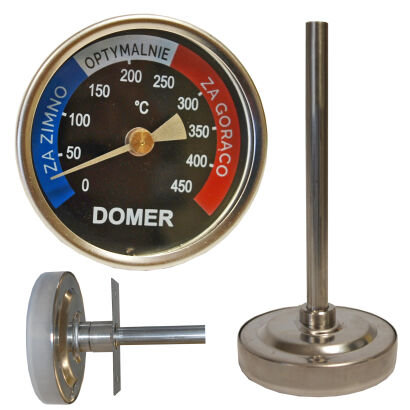
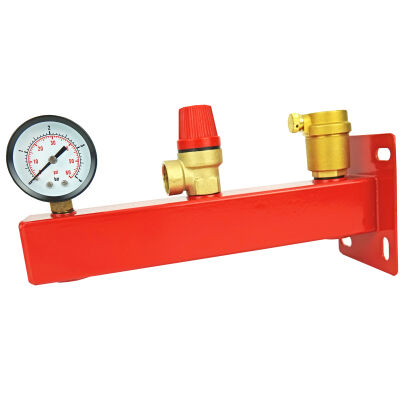
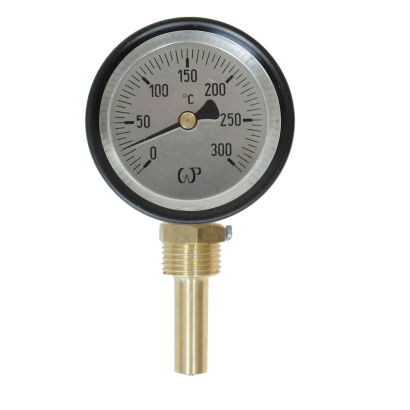
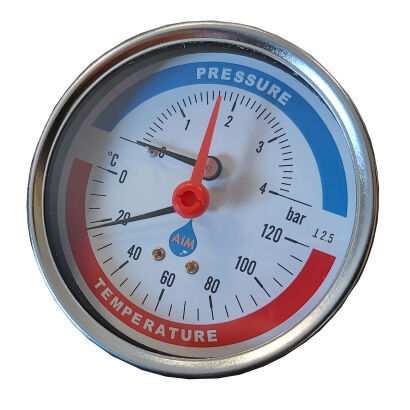
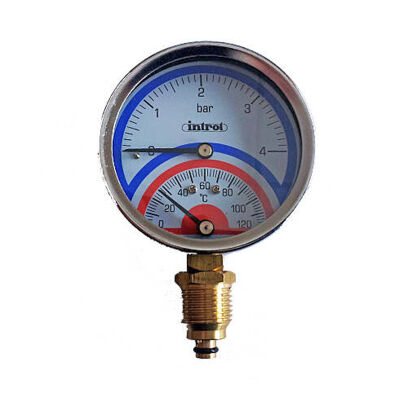
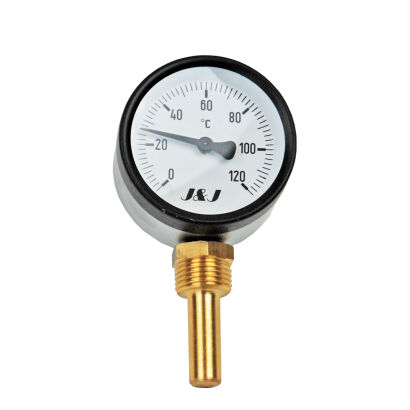
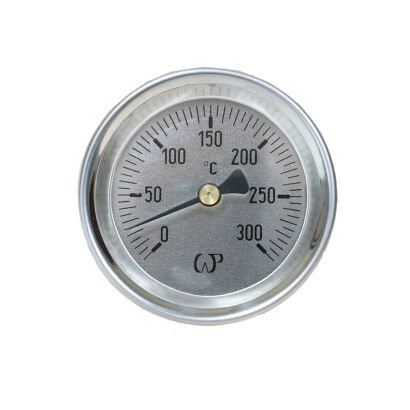
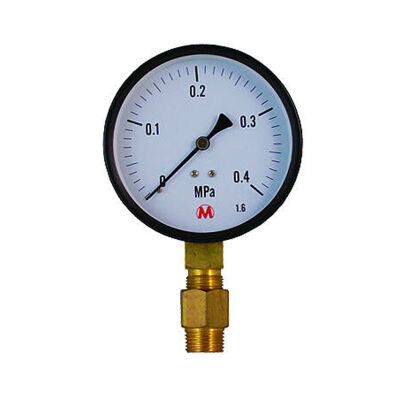
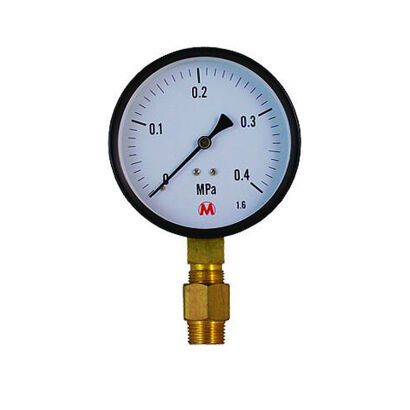
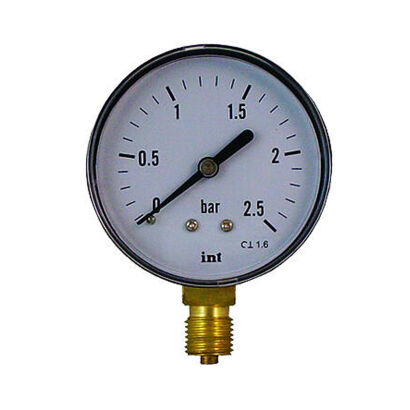
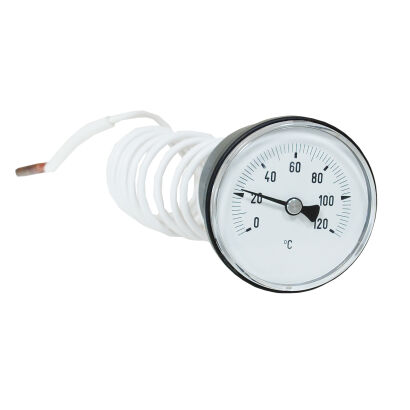
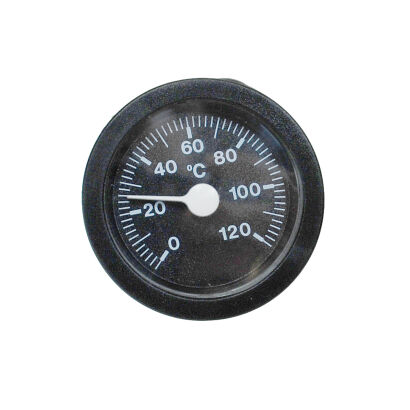
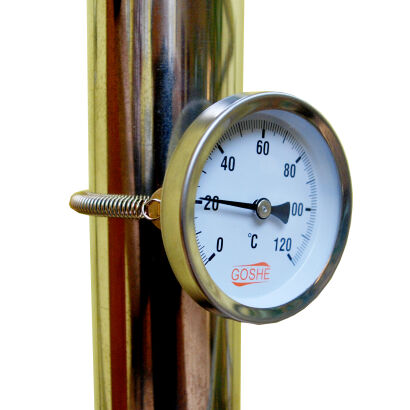
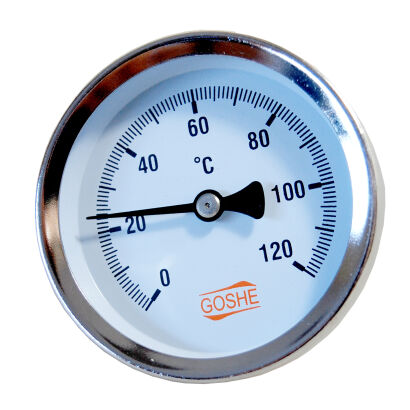
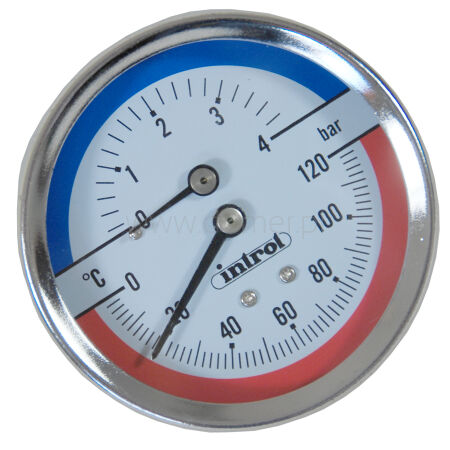
Measuring fittings in the boiler room allow controlling temperature and pressure based on readings, not assumptions. When a furnace thermometer is needed, the measurement point is first determined, because a different instrument is selected for the boiler body, another for the central heating pipe, and yet another for the flue pipe, which is the section that removes exhaust gases. A set of thermometer and manometer facilitates the work of the installer, service technician, and boiler room owner, as it allows quick assessment of the system's condition.
The selection does not end with the appearance of the dial. The thread size of 1/2 inch or 3/4 inch, the straight or vertical variant, the band version, and the measurement range adapted to the temperature of water, exhaust gases, or pipe all matter. A diameter of FI 60 or FI 63 improves readability of the indications, and the color of the casing or white dial has a secondary significance when the fittings need to stand out against the boiler background.
Where does the furnace thermometer work and which variant to choose?
The central heating furnace thermometer should measure precisely at the point where the reading is needed for operation or adjustment. Measuring the water temperature in the boiler requires a different design than measuring on the supply pipe, and the highest range is needed for exhaust gases. The working location immediately indicates the appropriate type of instrument:
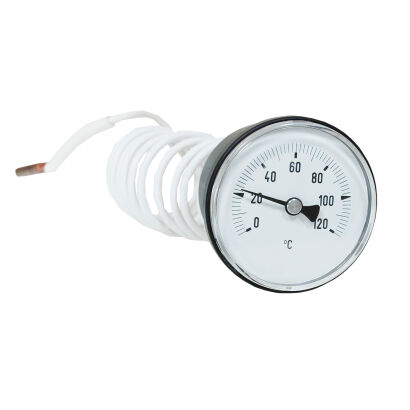
- round dial thermometers with a 1/2 inch or 3/4 inch thread for direct mounting in the boiler or heating device;
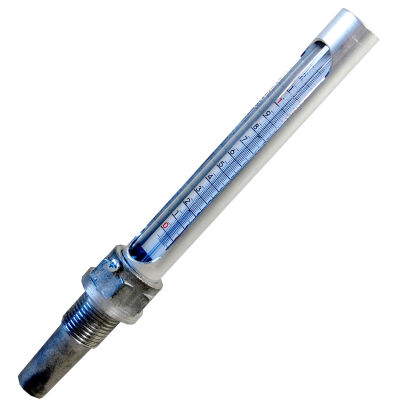
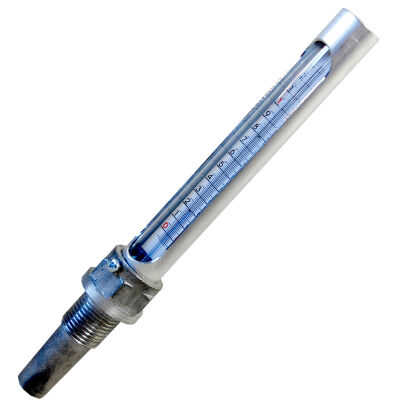
- straight and vertical thermometers for measuring sockets, when a quick reading from the front or top is important;
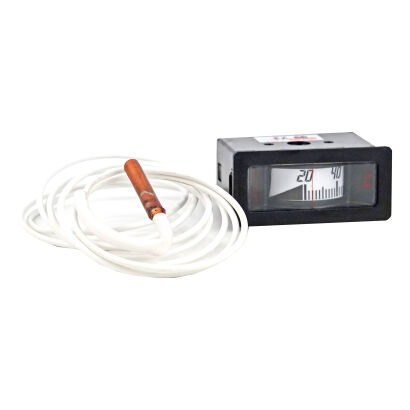
- rectangular thermometers with a capillary, i.e., a tube connecting the sensor with the indicator, when the measurement point and observation place are distant from each other;
- band or clamp thermometers for central heating pipes, when temperature must be measured on the pipe;
- thermometers for the flue pipe, when exhaust gas temperature needs to be controlled at a significantly higher range than for water.
An analog thermometer works well where the reading must be immediate and clear without power supply. The connection type must always be matched to the measuring socket or pipe diameter, because even the correct range will not compensate for incorrect installation.
Why do measuring fittings matter in a central heating installation?
Measuring fittings enable ongoing supervision of the boiler and the entire circuit operation. Temperature alone does not provide a complete picture, so alongside the thermometer, a manometer for the central heating boiler or a thermomanometer is often used. Only by combining these readings can it be assessed whether the system operates within the proper range.
In such a set, each element performs its own function:
- the thermometer monitors the temperature of water or exhaust gases and shows whether the boiler operates within the working range;
- the manometer controls the pressure in the installation and facilitates assessment of the filling state and circuit operation;
- the thermomanometer combines temperature and pressure readings at one point, saving installation space;
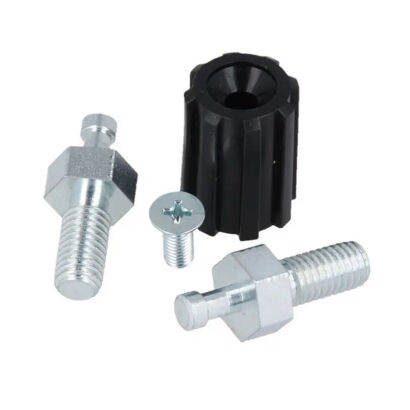
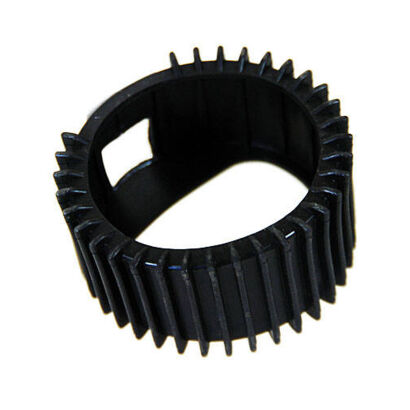
- spare parts for thermometers allow restoring measurement without replacing the entire fitting system.
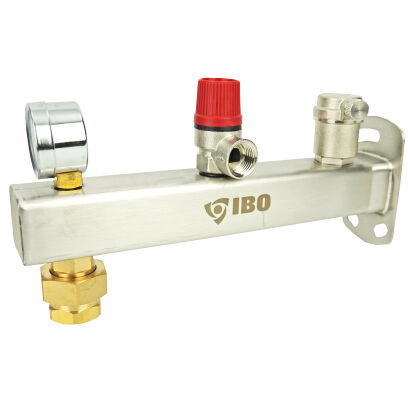
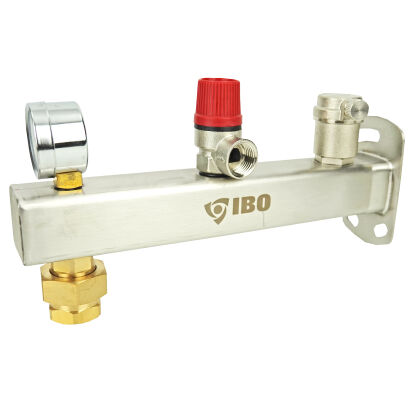
With limited installation space, combined versions with a pressure range up to 4 bar can also be practical. In closed systems, the manometer reading must be compared with the operation of the safety group, because measurement and protection must relate to the same operating state.
How to recognize incorrect temperature measurement?
An incorrect reading is usually visible by the behavior of the pointer, not by the value itself. When the scale does not respond to changes in boiler operation, the reading returns with a large delay, or after cooling does not return to the initial level, the measurement accuracy becomes doubtful. Some problems result from damage, others from improper selection or installation.
The most common causes of unreliable readings include:
- a loose clamp thermometer that does not fully contact the pipe;
- a bent capillary or routed in a way that limits sensor operation;
- a thread mismatched to the 1/2 inch or 3/4 inch socket;
- a sensor placed outside the main flow of heating water;
- a discrepancy between the reading from the boiler and the reading from the supply pipe that is not explained by the installation diagram.
When evaluating readings, it is best to compare two measurement points, not just the boiler casing temperature. Only then does the measurement have diagnostic value.
What temperature ranges are suitable for the boiler, pipe, and flue pipe?
The appropriate temperature range depends on the instrument's working location. On the central heating pipe, a scale from 0 to 120 °C is usually sufficient; a larger margin is needed at the boiler, and thermometers up to 450 °C are used for exhaust gas control mounted in the flue pipe. A range up to 300 °C makes sense where the sensor operates clearly above the typical heating water temperature.
When choosing, it is worth ensuring the design matches the working conditions:
- bimetallic version, not requiring power, for constant local reading at the boiler and heating devices;
- clamp version for pipes when the installation lacks a separate measuring socket;
- capillary version for remote reading without the need to stand at the measurement point;
- high-range version for exhaust gases, where a standard water thermometer will not be reliable.
The proper selection is determined by the mounting location, scale range, and reading method. When measuring fittings are consistently selected, boiler and installation operation runs more smoothly, and replacing a single element does not require rebuilding the entire measuring point.
FAQ
How to choose the type of thermometer for the mounting location?
The choice depends on the measurement point: dial thermometers with a 1/2 inch or 3/4 inch thread work well at the boiler, straight and vertical ones in sockets, clamp ones on pipes, capillary ones for remote reading, and special versions for measuring exhaust gas temperature.
How to recognize that the temperature measurement is unreliable?
Symptoms include weak pointer response, delays, or no return after cooling. Causes may be a loose clamp, bent capillary, mismatched thread, or sensor placement outside the main water flow.
What thermometer ranges should be used for water, pipes, and exhaust gases?
On the pipe, a range of 0–120°C is usually sufficient, while a larger margin is advisable in the boiler. For the flue pipe, thermometers with ranges up to 300–450°C are used. Also choose the appropriate design (bimetallic, clamp, or capillary) according to the mounting method.
 Polish
 Czech
 German
 Slovak
 Ukrainian