


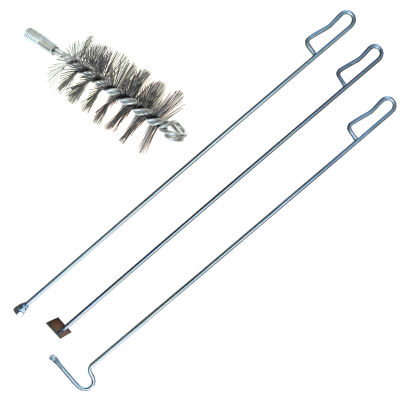


Furnace cleaning accessories help maintain the heat exchanger's clearance, stable draft, and efficient boiler operation throughout the season. This category includes tools for the combustion chamber, the flue pipe section between the boiler and the chimney, and the chimney itself, making it easy to choose both ready-made sets and individual furnace cleaning rods, handles, or soot removers.
2- and 3-piece sets as well as supplementary elements are available in lengths from 60 to 140 cm. This allows you to match a furnace cleaning brush, scraper, boiler cleaning hooks, or ash shovel to the depth of the channels and the boiler operation method.
How to tell when the furnace needs cleaning?
Regular deposit inspection gives a better picture than just observing the temperature on the controller. The furnace usually signals the need for cleaning by a drop in draft, slower heat absorption, and an increasingly thick layer of soot in the flue gas channels.
What symptoms appear earliest?
The most common signs are a dark coating in the combustion chamber, increased resistance when cleaning channels, and smoke when opening the doors. The flue pipe and chimney duct need to be cleaned more frequently when soot narrows the cross-section or flakes off in patches. A chrome chimney cleaning hatch with a 14 × 21 cm viewing window, i.e., an inspection opening for duct control, makes it easier to check the condition without dismantling covers.
Choosing a brush, cleaning rod, and handle according to duct cross-section
Furnace cleaning accessories are primarily selected based on the shape of the channel and the tool handling method. A brush that is too small cleans superficially, while one that is too large creates unnecessary resistance and complicates work in bends and narrowings.
Parameters and set composition determine the working range
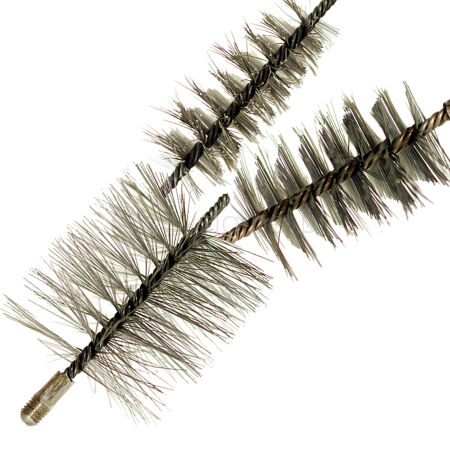
Round furnace cleaning brushes are available in diameters from 30 to 300 mm, while flat and square variants work well in rectangular channels and narrower heat exchanger spaces. The M-12 thread is the standard connection between the brush and handle, facilitating spare parts assembly. Handles for cleaning rods come in lengths of 60, 80, 100, 125, and 140 cm, also in a flexible 125 cm twisted version, allowing you to choose a tool for the flue pipe, combustion chamber, or vertical duct.
Ready 2- and 3-piece sets are practical for standard boiler maintenance, especially when a brush, scraper, and shovel are needed. Sets without a brush offer more flexibility where the duct diameter differs from the most commonly used sizes: 30, 40, 50, 60, or 70 mm. Narrow sets with hooks and scrapers reach corners and under heat exchanger shelves well.
How to clean the boiler, flue pipe, and chimney without random tools?
Cleaning the boiler is more efficient when each tool is matched to the work area. The scraper removes hard deposits from the combustion chamber, the furnace brush is used for final surface cleaning, and the chimney cleaning rod works well where a longer duct needs cleaning.
Tool selection usually looks like this:
- scrapers or flat scrapers (grackas) 60 or 80 cm long are used for the combustion chamber and firebox,
- a 60 cm long steel ash shovel is used for removing ash, coal, and dust,
- a steel furnace or chimney cleaning rod of appropriate diameter is used for round ducts,
- a chimney sweep ball weighing 2.5 or 3.5 kg with a guide wire and gloves is used for top-down cleaning.
A soot burning catalyst supports mechanical cleaning but does not replace it. The product works well as a supplement to regular boiler and chimney maintenance.
How often to clean and what to keep handy throughout the season?
The frequency depends on the fuel, boiler load, and heat exchanger design. It is worth regularly checking the combustion chamber, flue pipe, and soot deposition areas during the season, not just after power drops. Pre-season and post-season inspections are mandatory.
For regular maintenance, a basic set with a cleaning rod handle, brush, scraper, and shovel works best.
Soft soot comes off faster with a brush than hard clinker deposits on the heat exchanger walls. When the deposit is a compact, shiny coating, it is better to use a scraper or gracka first, then the brush. This order reduces brush wear and shortens work time.
After changing fuel or boiler settings, it is advisable to check the deposits after a few operating cycles, as this is when you can most quickly see if the rod diameter and cleaning method are correctly matched.
FAQ
How to choose the thread and handle length for the cleaning rod?
The standard thread is M-12, which facilitates parts assembly. Handles come in lengths of 60, 80, 100, 125, and 140 cm; a flexible 125 cm version is also available. Choose the length and type of handle according to the flue pipe, combustion chamber, or vertical duct.
What should a basic seasonal maintenance set include?
A basic set includes a cleaning rod handle, brush, scraper (gracka), and steel ash shovel. Ready 2- and 3-piece sets are practical for typical boiler maintenance.
When to use soot remover, and when scraper or brush?
The soot remover (catalyst) supports but does not replace mechanical cleaning. Soft soot comes off with a brush; hard clinker is removed first with a scraper, then a brush. After changing fuel, check deposits after a few cycles.
 Polish
 Czech
 German
 Slovak
 Ukrainian